Table of Contents
You can wipe out your business electricity bills with solar power. But choosing the wrong meter type will cost you thousands of rupees. You must understand the single phase vs three phase solar net metering difference before you buy. This knowledge keeps you from making a costly mistake.
Pakistan faces a massive energy crisis today. High electricity tariffs hurt small businesses every single day. Solar net metering offers a great way to fight back. Net metering lets you sell extra power back to the grid. The national grid then credits your account. This lowers your monthly bills. But you cannot just plug in any solar system. You must choose between single phase and three phase systems.
What is Net Metering in Pakistan?
Net metering is a billing system for solar users. The National Electric Power Regulatory Authority (NEPRA) manages these rules in Pakistan. When your solar panels make more power than you need, the extra goes to the grid. Your green energy helps your local power company.
In return, you get credits on your electricity bill. These credits offset the power you use at night. It is a simple way to save money. However, NEPRA has strict rules about who can sign up. Your connection type plays a massive role in this process. That is why the single phase vs three phase solar net metering difference matters so much.
Understanding Single Phase Systems
A single-phase connection is common in homes. It uses two wires. One wire is live, and the other is neutral. This setup delivers 230 volts. It easily powers lights, fans, and small appliances. Most small shops and home offices start with this connection.
However, single-phase setups have power limits. They cannot handle heavy loads. If you run multiple large air conditioners, a single-phase line will struggle. More importantly, Pakistan’s grid companies rarely allow net metering on single-phase lines. If you want to sell power back, a single-phase line is usually not enough. This limitation is a key part of the single phase vs three phase solar net metering difference.
Understanding Three Phase Systems
A three-phase connection uses four wires. It has three live wires and one neutral wire. This system delivers 400 volts. It provides a steady, continuous flow of power. It is perfect for heavy machinery, large offices, and big homes. You can learn more about electric power phases on Wikipedia if you want to study the science.
Three-phase systems handle voltage drops much better. They keep your electrical equipment safe. In Pakistan, grid operators require a three-phase connection for net metering. If you want to install a system larger than 5kW, you must use three phases. This requirement highlights the single phase vs three phase solar net metering difference for business owners.
The Single Phase vs Three Phase Solar Net Metering Difference
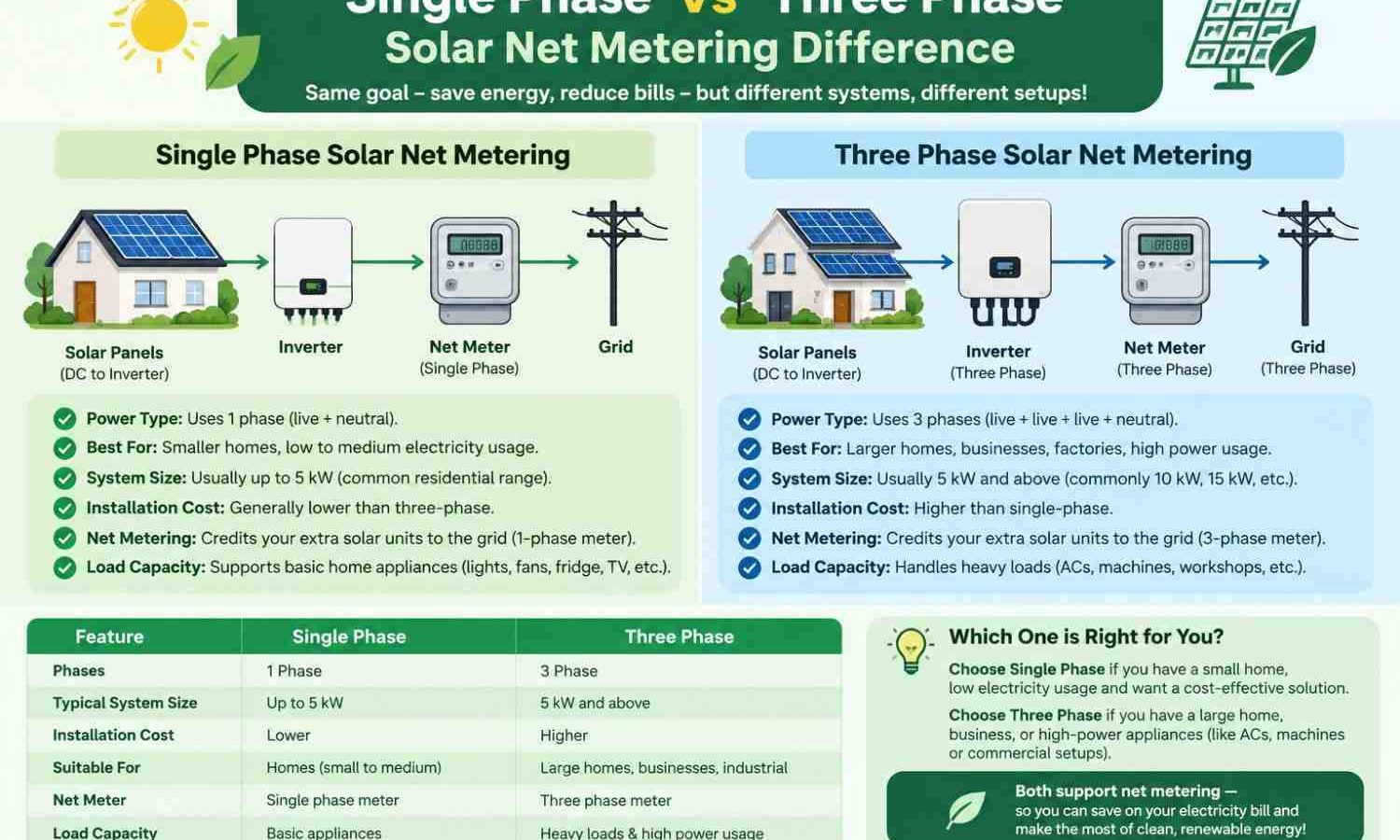
When we analyze the single phase vs three phase solar net metering difference, load capacity comes first. Single-phase lines usually support loads up to 5kW. Three-phase lines can support loads much higher than 5kW. This capacity affects how many solar panels you can install.
Another key part of the single phase vs three phase solar net metering difference is the physical meter itself. A net meter is bidirectional. It measures power going both ways. Pakistan’s green energy rules state that bidirectional meters must be three-phase. Single-phase bidirectional meters are not standard here.
Why does this rule exist? The grid needs balance. Sending power back on a single phase can upset the local grid. Three-phase net metering shares the load across three wires. This keeps the grid stable. This comparison shows why the single phase vs three phase solar net metering difference is so critical for planning.
| Feature | Single Phase Setup | Three Phase Setup |
|---|---|---|
| Number of Wires | 2 Wires (1 Live, 1 Neutral) | 4 Wires (3 Live, 1 Neutral) |
| Standard Voltage | 230 Volts | 400 Volts |
| Net Metering Support (PK) | Very Rare / Not Approved | Fully Approved and Standard |
| Maximum Load Limit | Usually up to 5 kW | Virtually Unlimited (Based on Sanctioned Load) |
| Grid Stability | Lower (May cause phase imbalance) | High (Balanced load distribution) |
Why NEPRA Rules Matter for Pakistan Businesses
In Pakistan, local power companies like LESCO, K-Electric, and IESCO follow NEPRA guidelines. Currently, these companies do not offer net metering licenses to single-phase consumers. If you have a single-phase meter, you cannot legally export power. You can only use solar power in real-time.
This means you lose money on holidays or weekends. When your business is closed, your solar panels still make power. Without net metering, that extra energy is wasted. To avoid this waste, you must upgrade. Knowing the single phase vs three phase solar net metering difference helps you plan this upgrade early.
Cost Implications for Small Businesses
Why does the single phase vs three phase solar net metering difference affect your wallet? Upgrading your connection costs money. You must pay your local utility company to switch your meter. This process requires new wiring, a new meter, and test reports.
The cost of a three-phase net meter is higher than a standard meter. You also need a three-phase green meter. However, the return on investment is massive. A three-phase system lets you export more power. This speeds up your payback period. Most businesses recover these costs in less than three years. This makes understanding the single phase vs three phase solar net metering difference highly profitable.
Choosing the Right Solar Inverter
Inverter selection also depends on the single phase vs three phase solar net metering difference. Solar inverters turn DC power from panels into AC power. If you have a three-phase connection, you must buy a three-phase inverter. These inverters are slightly more expensive but highly efficient.
If you are setting up your system, you must configure your settings correctly. For example, battery settings can change how your system behaves. You can read our amazing Knox solar inverter settings for tubular battery guide to learn more. Proper configuration ensures you do not waste power before exporting it.
How to Upgrade to a Three Phase Net Metering System
Upgrading your system requires a few clear steps. Do not worry; the process is straightforward if you follow the rules. A professional installer can handle the technical work for you.
- Contact a solar installer approved by the Alternative Energy Development Board.
- Apply for a load upgrade with your local power company.
- Install a three-phase green meter.
- Get your system inspected by the utility team.
- Sign the net metering agreement to start saving.
Each step requires attention to detail. Having a professional guide you makes it easy. They understand the single phase vs three phase solar net metering difference and will handle the paperwork quickly.
Monitoring Your Solar System Performance
Once your three-phase system is live, you must monitor it. Smart inverters connect to the internet to show your daily generation. This helps you track how much power you send to the grid.
To monitor your solar generation online, you need a stable internet connection. Many businesses use packages like the Ufone 4G device packages monthly unlimited to keep their smart inverters connected. This ensures you never lose track of your savings. Understanding the single phase vs three phase solar net metering difference ensures you get the most out of your monitoring tools.
Real-World Scenarios for Pakistani Businesses
Let us look at a real-world example. Imagine a small tailoring shop in Lahore. They have four sewing machines and two fans. Their load is small, so they use a single-phase connection. They want to install a 3kW solar system.
If they keep their single-phase connection, they cannot get net metering. On Sundays, when the shop is closed, their solar energy goes to waste. If they understand the single phase vs three phase solar net metering difference, they will upgrade to three-phase. Even with a small 3kW load, upgrading allows them to earn credits on Sundays.
Now, imagine a small supermarket. They run commercial fridges and air conditioning. Their load is already on a three-phase connection. For them, adding a 15kW solar system with net metering is easy. They do not need to upgrade their meter connection. They only need to install the bidirectional green meter to start saving.
Grid Stability and Safety
Utility companies focus on the single phase vs three phase solar net metering difference to balance the grid. When many single-phase systems export power, they can overload one specific line. This causes voltage fluctuations. These fluctuations can damage electronics in your neighborhood.
Three-phase net metering spreads the exported power evenly. This protects the local grid transformer. It also keeps your business appliances safe from power surges. Reliable energy is crucial for keeping your business running smoothly. This stability is another reason why authorities prefer three-phase systems.
Summary and Final Recommendation
To sum up, the single phase vs three phase solar net metering difference is about rules and power. If you want to save money through net metering in Pakistan, you need a three-phase system. Single-phase systems are good for simple use but do not support grid export.
Investing in a three-phase upgrade is worth every rupee. It opens the door to complete energy freedom. Your business will save money, reduce waste, and build a greener future.
Frequently Asked Questions
What is the main single phase vs three phase solar net metering difference?
The main difference is that three-phase systems support net metering and power export in Pakistan, while single-phase systems generally do not. Three-phase systems use four wires and supply 400 volts, which allows safe and balanced power export back to the grid.
Does the single phase vs three phase solar net metering difference affect solar system costs?
Yes, the single phase vs three phase solar net metering difference affects your initial setup costs. A three-phase system requires a more expensive inverter, an upgraded connection from your utility company, and a three-phase bidirectional green meter. However, it pays off faster by allowing you to sell excess power.
Can I ignore the single phase vs three phase solar net metering difference if I do not net meter?
Yes, if you only plan to use solar power in real-time without exporting to the grid, you can use a single-phase hybrid solar system. However, you will lose any extra electricity your panels make when your business is closed or when your power needs are low.
What is the minimum solar system size for net metering in Pakistan?
In Pakistan, net metering is typically approved for systems starting from 3kW or 5kW, depending on your local distribution company. However, because net metering requires a three-phase connection, you must upgrade your meter even if your system is relatively small.
How long does it take to upgrade to a three-phase meter in Pakistan?
Upgrading to a three-phase meter and getting net metering approval usually takes between 1 to 3 months. The process involves submitting an application to your local utility company, getting your site inspected, installing the green meter, and signing the final agreement.
Last updated: September 19, 2026
Written by Bilawal Qureshi (Software Developer and AI Expert).
Have questions or ready to get started? Get in touch with our team or chat with us on WhatsApp.