
Table of Contents
If you are wondering how many solar panels needed for 1 ton inverter ac units to run your business cooling for free, you are in the right place. Running an air conditioner can quickly drain your small business budget, but switching to solar power is a smart, long-term solution. By sizing your system correctly, you can enjoy free cooling for your office or shop without overpaying for unnecessary equipment.
Many business owners struggle with rising energy costs. By choosing the right setup, you can run your AC during peak hours without drawing expensive power from the utility grid. Let us look at how these systems work to find your perfect setup.
Why Power Usage Determines Your Solar Sizing Needs
Before we calculate the panels, we must understand how your AC uses power. A standard 1-ton inverter AC does not run at full speed all the time. Instead, it changes its compressor speed based on the room temperature. This smart feature makes it highly efficient.
A typical 1-ton inverter AC consumes about 1,000 to 1,200 watts of power when it first starts up. Once the room reaches your desired temperature, the power draw drops significantly. It often falls to just 300 to 500 watts per hour. This variable power draw is why business owners must carefully calculate their solar requirements.
According to data sources like Statista, energy costs are rising globally, pushing more businesses to adopt solar. To keep your system affordable, you should not buy more panels than you actually need.
In many countries, ACs have star ratings or energy efficiency ratios. A 5-star AC uses less energy than a 3-star AC. If you own a highly rated AC, you might reduce your overall solar installation size even further. This shows why picking efficient appliances is so important.
The Step-by-Step Solar Calculation
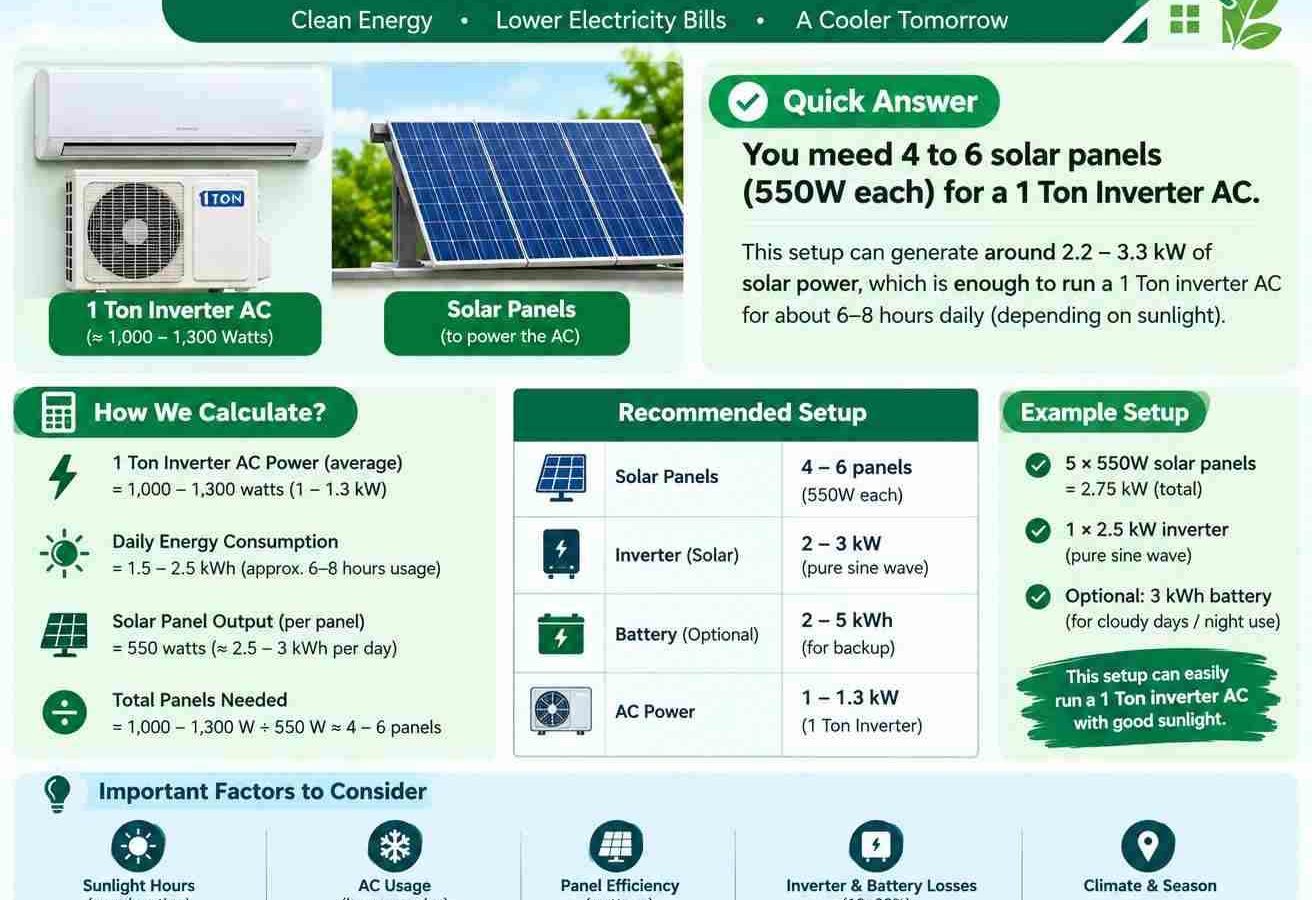
To find how many solar panels needed for 1 ton inverter ac setups, we must look at your daily usage. Let us assume you run your office AC for 8 hours during the hottest part of the day.
In those 8 hours, your AC will not use 1,000 watts constantly. On average, it might draw about 600 watts per hour. This means your daily energy consumption for the AC is around 4.8 kilowatt-hours (kWh) or units of electricity.
Now, let us look at solar panel generation. A standard solar panel today has a rating of about 400 watts. In most sunny regions, you can expect around 4 to 5 hours of peak sunlight per day.
We multiply the panel size by the sun hours to find the daily output. For example, a 400-watt panel multiplied by 4.5 peak sun hours gives you 1,800 watt-hours (or 1.8 kWh) of electricity per day. To cover your 4.8 kWh AC usage, you divide 4.8 by 1.8. This calculation gives you 2.6 panels.
However, solar systems always face minor energy losses from heat, dust, and wiring. Because of these losses, we must add a 20% safety margin. This means the actual number of panels required is at least 3 to 4 panels of 400 watts.
Keep in mind that sunlight hours change with the seasons. In the summer, you might get 6 hours of strong sun. In the winter, you might only get 3 hours of weak sun. However, since you rarely use your AC in winter, your summer calculations are the most important.
The Exact Math: Solar Panel Requirements by Wattage
Different panels have different power ratings. If you choose larger panels, you will need fewer of them. If you choose smaller panels, you will need more. Here is a simple breakdown to help you plan.
This table shows how panel wattage changes the total number of panels you will need.
| Panel Wattage | Daily Output per Panel (4.5 Sun Hours) | Number of Panels Needed for 1 Ton AC | Total System Wattage |
|---|---|---|---|
| 300 Watts | 1.35 kWh | 5 Panels | 1500 Watts |
| 400 Watts | 1.80 kWh | 4 Panels | 1600 Watts |
| 540 Watts | 2.43 kWh | 3 Panels | 1620 Watts |
Knowing these differences allows you to fit panels onto limited roof spaces. If you have plenty of roof space, cheaper 300-watt panels might work. If space is tight, go for highly efficient 540-watt panels.
Why Inverter ACs Are Better for Solar
You might wonder if you can run a non-inverter AC on solar. You can, but it is much harder. Non-inverter ACs use a fixed-speed compressor that turns on and off. Every time it turns on, it demands a massive surge of current.
This surge can be three times higher than the running power. To handle this peak, you would need a very large solar inverter. An inverter converts the direct current (DC) from your panels into alternating current (AC) for your appliances. You can learn more about how inverters work on Wikipedia.
In contrast, an inverter AC starts slowly. It does not create huge power spikes. This gentle start means your solar inverter can be smaller and cheaper. Before deciding on your solar configuration, you must understand this starting current advantage.
If you are setting up your solar inverter with a battery system, proper configuration is key. For those using Knox systems, reading our Amazing Knox Solar Inverter Settings for Tubular Battery Guide will help you get the best performance.
Off-Grid vs. On-Grid: How It Affects Panel Count
Your choice of solar system type changes your total installation requirements. There are two main types of systems: on-grid and off-grid.
An on-grid system connects directly to your local power grid. If your panels do not produce enough power, the grid supplies the rest. This system is great because you do not need batteries. You only need enough panels to cover your average daily usage. For a 1-ton inverter AC, 4 panels of 400 watts are usually perfect for an on-grid system.
An off-grid system operates completely separate from the power grid. It requires batteries to store electricity for cloudy days or nighttime use. If you want to run your AC at night, you must generate extra power during the day to charge your batteries. In this case, the total panel count increases. You will need around 6 to 8 panels of 400 watts. This extra capacity ensures you generate enough power to run the AC and charge the battery bank at the same time.
For businesses that operate purely during daylight hours (9 AM to 5 PM), on-grid systems are highly recommended. You use the solar power as it is generated, avoiding battery costs entirely.
Real-World Factors That Affect Panel Performance
Calculations on paper do not always match real-world results. Several environmental factors will affect how your solar panels perform. Your location’s weather directly impacts your actual solar output.
First, look at your local climate. If you live in an area with frequent cloud cover, your panels will produce less energy. You will need to add one or two extra panels to compensate. Second, consider the angle of your roof. For maximum solar energy, your panels must face the sun directly. If your roof has an awkward angle or suffers from tree shading, production will drop. Shading on even a small part of a panel can cut its output by half.
Third, keep your panels clean. Dust, leaves, and bird droppings block sunlight. Cleaning your panels once a month can boost their energy output by up to 15%. When you maintain your system well, you can stick to the minimum estimated panel count.
Choosing the Right Solar Inverter and Battery
To run your AC smoothly, the panels are only half the equation. You also need a high-quality solar inverter. For a 1-ton inverter AC, we recommend a solar inverter with a capacity of at least 2 kW (kilowatts) or 2.5 kVA. While figuring out your solar array size, do not forget the inverter rating.
This size ensures the inverter can handle the AC along with other small office appliances like lights, fans, and laptops. If you choose an off-grid system, you also need to select the right batteries. Tubular batteries or lithium-ion batteries are the most common choices.
For standard tubular batteries, you will need at least a 24V (volt) system. This usually means two 12V batteries connected in a series. This setup provides enough storage capacity to keep your AC running smoothly during passing clouds.
To protect your batteries, do not discharge them completely. This is called keeping a healthy Depth of Discharge (DoD). Keeping your batteries above 50% capacity will double their lifespan. This tip is crucial when designing your system to ensure your batteries have enough juice to survive the night.
Boosting Your Business Beyond Solar
Saving money on electricity is a great way to grow your small business. It frees up cash flow that you can reinvest in growth. However, physical energy is not the only thing you should optimize. Your team’s daily workflow also deserves an efficiency upgrade.
Just as solar panels automate your power production, modern AI tools can automate your customer service and marketing. By integrating smart digital solutions, you can save hours of manual labor every single day.
For example, you can explore the Incredible Ways Chatgpt Ai Assistants Can Boost Your Business to streamline your operations. Furthermore, setting up custom tools can take your customer relations to the next level. You can check our Unlock Amazing Growth with Custom AI Chatbot Development guide to see how automated chat systems can capture more leads while you focus on running your business.
A Quick Checklist for Your Solar AC Project
Before you buy any hardware, use this checklist to ensure you have covered all the bases. This simple checklist keeps your project on track and ensures maximum efficiency:
- Verify the exact wattage and star rating of your 1-ton inverter AC.
- Measure your roof space to ensure you have room for 4 to 6 large panels.
- Determine your needed panel count based on your local daily peak sun hours.
- Consult a local solar installer to check for roof shading issues.
- Choose between an on-grid system (no batteries) or an off-grid system (with batteries).
- Invest in a high-quality inverter of at least 2 kW capacity.
- Set up a monthly maintenance schedule to keep your panels clean and highly efficient.
By following these steps, you can confidently invest in solar power and watch your energy bills drop immediately.
Frequently Asked Questions
Can I run a 1 ton inverter AC on solar without batteries?
Yes, you can run a 1-ton inverter AC on solar without batteries if you use an on-grid solar system. This system connects to the local power grid, which stabilizes the power supply when clouds pass by.
What happens if I install too few solar panels?
If you install too few solar panels, your system will not generate enough electricity to run the AC. The AC will either shut down or draw power from the grid, which defeats the purpose of saving money.
Is a 1 ton inverter AC enough for a small office room?
Yes, a 1-ton inverter AC is usually perfect for a room size of up to 120 to 150 square feet. If your office room is larger, you might need a 1.5-ton AC, which will require more solar panels.
How long do solar panels last?
Most high-quality solar panels come with a performance warranty of 25 years. They will continue to produce clean electricity for decades with very little maintenance.
Do solar panels work on cloudy days?
Yes, solar panels still work on cloudy days, but their power generation drops by 50% to 90%. This is why calculating your solar system size with a small safety margin is highly recommended.
Last updated: September 19, 2026
Written by Bilawal Qureshi (Software Developer and AI Expert).
Have questions or ready to get started? Get in touch with our team or chat with us on WhatsApp.