Table of Contents
You probably use ChatGPT every day to write quick emails or brainstorm blog ideas, but what does gpt stand for? Knowing this term is the first step to unlocking the true power of artificial intelligence (AI) for your business.
Many small business owners feel overwhelmed by new technology. They think AI is too complex or hard to learn. However, once you learn what does gpt stand for, the technology becomes much easier to understand. This guide will break down the term in simple words so you can use it to grow your business today.
The Core Meaning: What Does GPT Stand For?
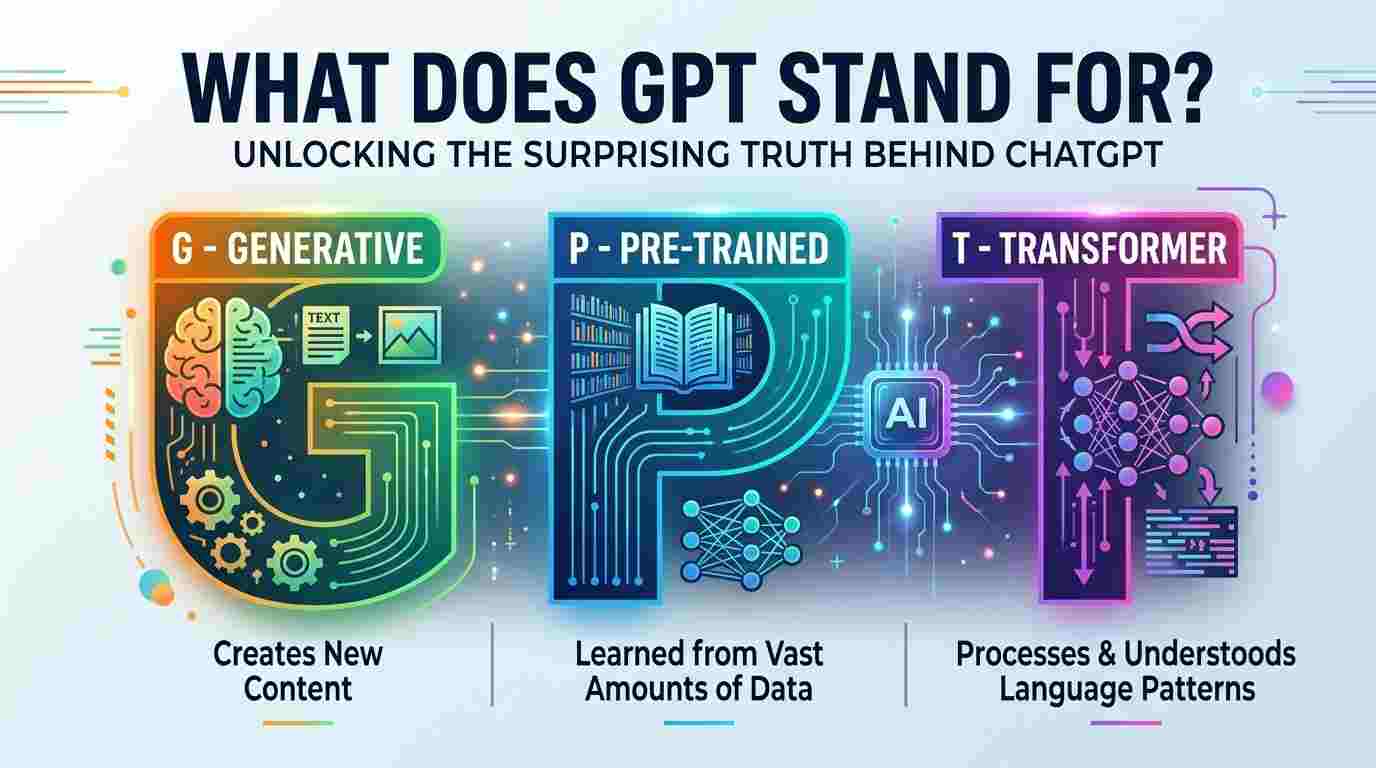
Let us start with the exact definition. The letters GPT stand for Generative Pre-trained Transformer. That sounds like a complex term from a science fiction movie. However, we can break down these three words into plain English so they make complete sense.
The first word is Generative. This means the AI can create or generate new content. It does not just copy and paste answers from a database. Instead, it writes fresh text, drafts emails, or creates ideas from scratch. It acts like a creative writer on your team. For example, if you need a newsletter about a summer sale, the AI can write a unique draft in seconds. This saves you from having to hire an expensive copywriter for simple tasks. It allows you to produce more marketing content with less budget.
The second word is Pre-trained. This means the system has already studied a massive library of information. Before you ever type a prompt, the model has read millions of books, articles, and websites. This deep training helps the AI learn how human language flows. You do not need to spend weeks teaching the software about grammar or spelling. It is ready to help you from the very first minute. This pre-training saves you valuable onboarding time.
The third word is Transformer. This is a modern type of computer program invented by researchers at Google in 2017. It helps the computer read whole sentences at once instead of word by word. This allows the AI to understand the context of your words much better. Older systems would get confused if a word had two meanings. The transformer model looks at the surrounding words to choose the right meaning. This makes your conversations with the AI feel natural and smooth.
When you ask what does gpt stand for, you are looking at a system that creates new content based on its deep training. It uses a transformer design to understand your requests perfectly. It is a highly trained writing engine built on smart computer code.
A History of the Tools: What Does GPT Stand For?
It is helpful to know where this technology came from. A research group called OpenAI created the very first GPT model in 2018. Before this, most online chatbots were very basic and hard to use. They could only answer simple questions with pre-written scripts.
The first model, GPT-1, was a basic test. OpenAI wanted to see if a transformer network could learn from raw text. It could write simple sentences but made many funny mistakes. It had a small vocabulary and could not handle complex requests. However, it proved that the basic concept worked. This paved the way for larger models.
Soon after, OpenAI released GPT-2. This version was much bigger and had 1.5 billion parameters. Parameters are the internal settings that help the AI make decisions. GPT-2 could write short essays and tell stories. It was so good that OpenAI initially did not release it to the public. They worried that bad actors might use it to create spam or fake news. This showed the world that AI was growing fast and could have a massive impact.
In 2020, GPT-3 was released with 175 billion parameters. This model was a massive leap forward. It could write high-quality blog posts, draft computer code, and translate languages instantly. Business owners started to realize they could use this tool to save time. It was the first model that felt truly human in its writing. This release started the current AI boom.
Today, we have GPT-4 and GPT-4o. These are highly advanced tools that can analyze files, read images, and speak out loud. When you ask what does gpt stand for today, you are talking about the most advanced writing tools on earth. They can score in the top ten percent on complex legal exams. This shows how far the technology has come in just a few years.
Why Your Small Business Needs to Understand GPT
As a business owner, you have a lot on your plate. You must handle marketing, sales, customer support, and bookkeeping. This is why knowing what does gpt stand for is so important. It gives you a way to save hours of hard work every single week.
Imagine having a super-fast assistant who works for free. That is what AI tools can do for your business. You do not need to hire a large team to get your marketing done. A single person using GPT can do the work of three people. For example, a small bakery can use the tool to write social media posts, reply to reviews, and draft recipes. This saves the owner hours of computer work.
Many small businesses are already using this technology to get ahead. According to a recent study by Statista, thousands of small businesses now use AI to handle routine tasks. They can launch marketing campaigns in minutes instead of weeks. They can also provide twenty-four hour customer support using simple AI chatbots. This helps them compete with much larger companies.
To show you how fast this trend is growing, look at the rapid rise of AI adoption among small businesses over the last few years:
| Year | Small Business AI Adoption Rate |
|---|---|
| 2021 | 15% |
| 2022 | 25% |
| 2023 | 44% |
| 2024 | 67% |
You do not need a massive budget to use these tools. Most GPT tools are very affordable or even free. Once you know what does gpt stand for, you can start using it to grow your brand. It levels the playing field for small businesses everywhere.
How GPT Models Work in Plain English
You do not need to be a computer scientist to use AI, but knowing how it works is very helpful. When we ask what does gpt stand for, we also want to know how it thinks. The answer is that it does not actually think like a human.
Instead, the AI uses math to predict words. When you type a prompt, the AI turns your words into small pieces called tokens. Think of a token as a single syllable or part of a word. The model then looks at those tokens and searches its training for patterns.
The AI asks itself what word is most likely to come next. It does this word by word, very quickly. It is like the auto-correct on your phone, but much smarter. It calculates the statistical probability of every word in its vocabulary. Then, it selects the best fit.
Because it predicts words, the AI can sometimes make mistakes. It does not actually know if a fact is true or false. It only knows that the words sound right together. This is why you must always read the AI’s work before you use it. Knowing what does gpt stand for helps you remember that the AI is a predictor, not a human expert. Always treat its output as a draft that needs your final approval.
Search Engines vs. GPT: What Does GPT Stand For?
Many people confuse GPT with search engines like Google. However, they are completely different tools. Knowing the difference is key to using them correctly in your business.
A search engine acts like a library catalog. When you search for something, it gives you a list of links to other websites. You must click those links and read the pages to find your answer. The search engine does not write anything new. It only helps you find what others have already written.
A GPT model acts like a smart research assistant. It has already read those websites for you. Instead of giving you links, it writes a custom answer just for you. It can summarize complex topics, translate languages, or write a custom email based on your instructions. It synthesizes information to create a unique response.
When you understand what does gpt stand for, you see that it is not just a search tool. It is a creation tool. Use search engines when you need to find a specific website or check a live fact. Use GPT when you need to create something new or simplify complex data. Combining both tools will make your business incredibly efficient.
Comparing Different GPT Models
Not all GPT models are the same. Some offer high speed, while others focus on deep thinking. It is important to choose the right model for your business tasks. If you use the wrong model, you might waste time or money.
If you use a basic tool, you are likely using an older model like GPT-3.5. These are great for daily writing and brainstorming. They respond quickly and cost very little to use. However, they can struggle with complex math or deep logic.
If you need to analyze complex data or write legal contracts, you should use a modern model like GPT-4. These models have more training and can handle difficult logic. They make fewer mistakes and can follow complex guidelines. They are slower but much smarter.
There is also GPT-4o, which is the latest flagship model. It can handle text, voice, and images in real-time. This makes it perfect for creative tasks like designing ads or translating spoken conversations.
Here is a simple table to help you compare the most common models used in business:
| Model Name | Key Strength | Best Business Use | Speed Rating |
|---|---|---|---|
| GPT-3.5 | High speed, low cost | Basic customer support chat | Very Fast |
| GPT-4 | Deep reasoning, high accuracy | Writing complex contracts, data analysis | Moderate |
| GPT-4o | Multimodal (handles text, voice, images) | Real-time voice translation, marketing design | Fast |
As you can see, the answer to what does gpt stand for keeps evolving. The models are getting faster and more capable every single month. Your business can start with a basic model and upgrade as your needs grow.
How to Write Amazing Prompts for GPT
The secret to getting great results from AI is writing good prompts. A prompt is the instruction you type into the tool. If you write a poor prompt, you will get a poor response. Writing prompts is a skill called prompt engineering.
First, give the AI a clear role. Tell it to act like a professional copywriter, a helpful customer service agent, or a business coach. This helps the model choose the right tone for your text. For example, say, “Act as an expert accountant” if you want financial tips.
Second, give the AI clear context. Do not just say, “Write an email.” Instead, say, “Write a polite email to a customer explaining why their shipment is delayed by two days.” This specific context prevents the AI from writing generic text. It ensures the email fits your exact situation.
Third, tell the AI how to format the output. You can ask for bullet points, a short paragraph, or a numbered list. You can also specify the length, such as “under 100 words.” This saves you from having to edit the text later. When you ask what does gpt stand for, you are asking for a tool that responds perfectly to clear, smart instructions.
How GPT Fits Into Your SEO and Website Strategy
Many small businesses use AI to help with their search engine optimization (SEO). SEO is the process of getting your website to show up on search engines like Google. Having a strong SEO strategy is key to getting free traffic to your website.
You can use GPT to write blog outlines, find keywords, and draft meta descriptions. A meta description is the short summary of your page that shows up in search results. The AI can write dozens of these in minutes. This can speed up your content creation process dramatically.
However, you must be careful not to rely on the AI too much. Search engines want to show high-quality, helpful content written for real people. If your website is full of low-quality AI text, your rankings might drop. You should use GPT to help you write, but always add your own human touch, stories, and expertise.
At Nextgen, we help businesses build websites that rank high on search engines. We know how to combine AI tools with human creativity to get the best results. You do not have to worry about what does gpt stand for when you work with our expert team. We build the perfect strategy for your brand.
Five Ways to Use GPT: What Does GPT Stand For in Practice?
Let us look at five easy tasks you can hand over to your AI assistant today. These will save you time and help you focus on growing your sales. Knowing what does gpt stand for lets you make the most of these amazing tools every day.
- Drafting Client Emails: Copy a client’s question and ask the AI to write a polite, helpful reply. This is great for handling difficult customer situations. The AI remains calm and professional even when the customer is angry.
- Creating Social Media Posts: Ask the AI to write five catchy captions for your Instagram or Facebook page based on a new product. You can ask it to include emojis and popular hashtags to get more views.
- Writing Product Descriptions: Paste a list of your product’s features and ask the AI to write an exciting description that makes people want to buy. It can turn a boring list of specs into copy that sells.
- Summarizing Long Articles: If you do not have time to read a long business report, paste it into the tool and ask for a three-bullet-point summary. This helps you stay informed without wasting hours of reading time.
- Brainstorming Blog Topics: Ask the AI for ten blog post ideas that would interest your target audience. You can give it your industry and target customer, and it will generate endless creative ideas.
Once you start delegating these tasks, you will see how helpful the technology is. Understanding what does gpt stand for allows you to make the most of these amazing tools every day. You will free up your schedule for high-value business decisions.
How Nextgen Can Help You Navigate AI
Getting started with new technology can feel scary when you are busy running a business. You do not have to spend hours watching tutorials or reading technical articles. The team at Nextgen is here to help you navigate this transition.
At Nextgen, we specialize in helping small businesses build a strong digital presence. We build beautiful websites, set up smart marketing campaigns, and help you use modern tools like AI to your advantage. We believe that technology should serve your business, not cause more stress.
You do not need to be an expert on what does gpt stand for to grow your business. We will handle the complex technical work, SEO optimization, and website design so you can focus on what you do best. Contact Nextgen today to learn how we can help your business succeed online.
Frequently Asked Questions
What does GPT stand for?
When clients ask what does gpt stand for, the short answer is Generative Pre-trained Transformer. This is a type of computer program that can write text, write code, and answer questions like a human by predicting the next logical words.
What does GPT stand for in ChatGPT?
In ChatGPT, the letters gpt stand for Generative Pre-trained Transformer. The “Chat” part of the name simply means the model is set up to interact with you in a conversational, back-and-forth format.
Who created the GPT models?
A research organization called OpenAI created the GPT models. They launched the first version in 2018 and have since released several advanced versions, including GPT-3.5, GPT-4, and GPT-4o.
Is GPT free to use for business?
Yes, many tools built on GPT are free to use. For example, OpenAI offers a free version of ChatGPT that is perfect for simple business tasks. You can upgrade to a paid plan for faster speeds and advanced features.
Can GPT replace human employees?
No, GPT is designed to assist humans, not replace them. While it can draft text and brainstorm ideas quickly, it lacks real human emotion, personal experience, and critical thinking skills. It works best as an assistant for your team.
Last updated: August 11, 2026
[Author Bio: Add author name, credentials, and relevant expertise here before publishing.]
Have questions or ready to get started? Get in touch with our team.