Table of Contents
If you’ve started searching for a POS system, you’ve probably noticed the same thing every Pakistani business owner runs into: pricing is all over the place. One vendor quotes a few thousand rupees a month, another wants a one-time payment, and a third only gives you a price after a sales call.
This guide breaks down what POS software actually costs in Pakistan right now, what drives that price up or down, and what to check before you commit — including a look at Swift Restaurant POS and the core features it’s built around.
POS Software Price in Pakistan: Quick Answer
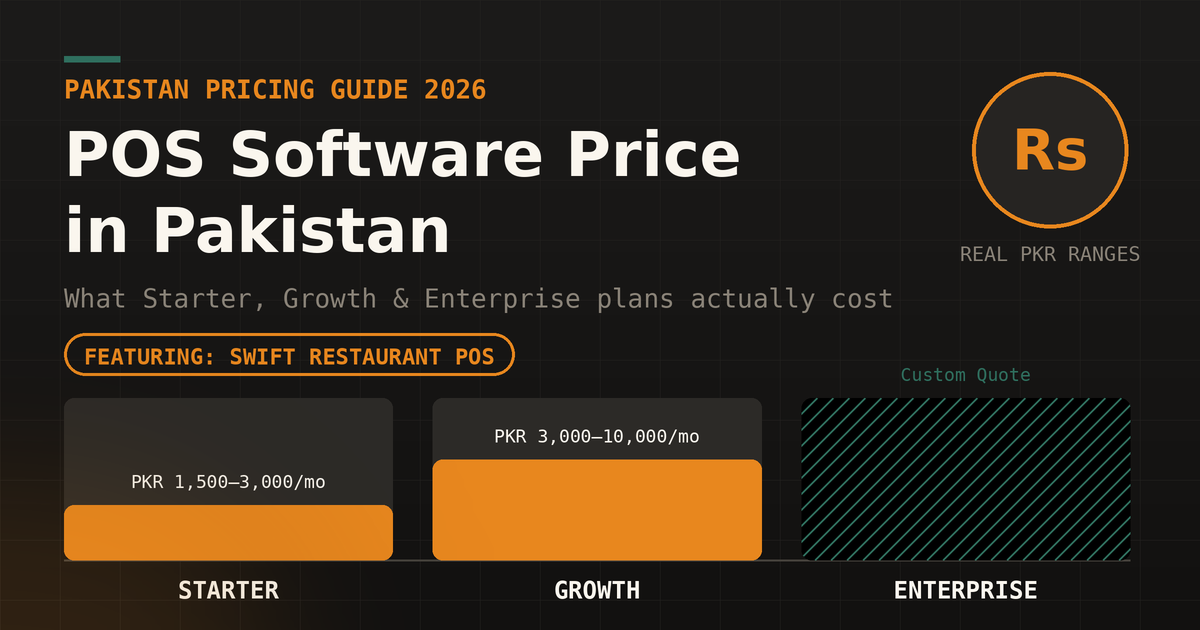
Most POS software in Pakistan falls into three broad pricing tiers:
| Tier | Typical Monthly Price (PKR) | Typical Yearly Price (PKR) | Best For |
|---|---|---|---|
| Starter / Basic | ~1,500 – 3,000 | ~18,000 – 35,000 | Single counter, small shop or cafe |
| Standard / Growth | ~3,000 – 10,000 | ~35,000 – 120,000 | Multi-terminal restaurants, growing retail |
| Enterprise | Custom quote | Custom quote | Multi-branch chains, franchises |
These are general market ranges based on publicly available pricing in Pakistan as of 2026 — always confirm current rates directly with any vendor, since pricing changes and often depends on your specific setup.
Some vendors also price per branch or per terminal rather than a flat monthly fee, so the number you see on a website isn’t always the number you’ll actually pay once you add a second counter or location.
What Affects POS Software Price in Pakistan?
Before comparing vendors on price alone, it helps to understand why prices vary so much in the first place.
1. Number of Terminals and Branches
Most Pakistani POS providers price around a base plan that includes one terminal and a set number of users. Adding extra terminals, counters, or branches usually increases the monthly cost — sometimes significantly for multi-location restaurants.
2. Offline Functionality
Internet reliability is a real concern for businesses across Pakistan. POS systems that keep working during outages and sync automatically once you’re back online tend to sit in a higher price bracket than basic cloud-only tools, simply because offline-first architecture costs more to build.
3. Tax and Compliance Features
Automatic FBR-compliant invoicing, and province-specific requirements like PRA (Punjab Revenue Authority) reporting, are increasingly standard asks. Software that handles this natively is usually priced above stripped-down billing tools that don’t.
4. Inventory and Reporting Depth
A basic billing tool that just rings up sales costs less than a system that also tracks stock levels, expenses, purchase orders, and generates owner-level reports. If inventory and cost control matter to your business, expect to pay for that depth.
5. Hardware Bundling
Some vendors quote a POS “price” that actually includes hardware — a receipt printer, cash drawer, barcode scanner, or a full terminal. Others price software only and expect you to source your own hardware. Always check whether a quoted price is software-only or hardware-inclusive before comparing two vendors side by side.
6. Support and Onboarding
Setup, staff training, data import, and ongoing support are sometimes included and sometimes charged separately. A cheaper monthly fee with no onboarding support can end up costing more in lost time than a slightly pricier plan that gets you running correctly from day one.
Typical Pricing Breakdown
Starter plans (~PKR 1,500 – 3,000/month) Usually cover one terminal, basic billing, receipt printing, and a limited number of users. A solid fit for small shops, single-counter cafes, or businesses just getting started with digital billing.
Standard / Growth plans (~PKR 3,000 – 10,000/month) This is where most full-service restaurants and growing retail businesses land. Expect inventory tracking, multiple users with role-based access, multi-device support, and more detailed reporting.
Enterprise plans (custom pricing) Multi-branch restaurant groups and larger retail chains typically move to custom-quoted plans that include centralized reporting across locations, HR and payroll features, and dedicated account support.
Spotlight: Swift Restaurant POS
Swift Restaurant POS is built around the core features restaurant owners in Pakistan actually need day to day, without a bloated feature list driving the price up.
Key features include:
- POS Billing — Fast, reliable billing designed to keep counter service moving even during peak hours.
- Multiple Shifts — Track sales and cash handling separately across shifts, making end-of-day reconciliation straightforward instead of a guessing game.
- Multi-Device Support — Run the system across multiple counters or devices without losing sync, so your setup can grow as your restaurant does.
- Inventory and Expenses — Keep stock levels and day-to-day expenses visible in one place, so your real food cost is a number you track, not one you discover later.
- User Roles (Admin, Manager, Waiter) — Give each team member exactly the access they need, with clear separation between front-line staff, management, and admin-level control.
For restaurants comparing POS software price in Pakistan, Swift Restaurant POS is worth a direct look if what you actually need is the operational essentials done well — billing, shifts, inventory, and access control — rather than a heavier enterprise system priced for problems you don’t have yet.
Hidden Costs to Watch For
When comparing POS software price in Pakistan, the advertised number is rarely the full picture. Ask about:
- Per-branch or per-terminal charges that apply once you scale beyond the base plan.
- Setup and training fees that may or may not be bundled into the monthly price.
- Payment processing fees if the POS is tied to a specific payment gateway.
- Hardware costs — printers, scanners, and cash drawers, if not included.
- Support tier differences — some vendors charge extra for priority or on-site support.
How to Choose Based on Price
- Match the tier to your actual size, not your five-year plan. You can usually upgrade later.
- Get the total monthly cost in writing — software, hardware, and any per-branch fees added together.
- Ask specifically about offline behavior if your area has unreliable internet.
- Confirm tax compliance features relevant to your province before assuming they’re included.
- Request a live demo rather than deciding from a pricing page alone — the feature list rarely tells you how the software actually feels during a busy shift.
Frequently Asked Questions
How much does POS software cost in Pakistan? Most POS software in Pakistan ranges from roughly PKR 1,500 to PKR 10,000 per month depending on features, number of terminals, and whether tax compliance or multi-branch support is included. Enterprise setups are typically custom-quoted.
Is there free POS software available in Pakistan? Some vendors offer free trials or limited free tiers, but fully-featured POS software with inventory tracking, multi-user roles, and tax compliance is generally a paid product in Pakistan.
Does POS software price in Pakistan include hardware? It depends on the vendor. Some quotes are software-only, while others bundle a printer, cash drawer, or full terminal into the price. Always confirm which one you’re looking at before comparing options.
Is Swift Restaurant POS a good option for small restaurants in Pakistan? Swift Restaurant POS is built around core operational features — billing, shift tracking, inventory and expenses, multi-device support, and role-based access — making it a strong fit for restaurants that want reliable day-to-day functionality without paying for unnecessary extras.